
A Brighter Dental Experience
Dental Botox and Injectables in Beverly Hills
If you wake up with a sore jaw, grind your teeth at night or get tension headaches from clenching, the muscles that move your jaw may be working far harder than they should. Dental Botox relaxes those overworked muscles with a few quick, targeted injections, easing the strain on your jaw joints and your teeth. At Applemint in Beverly Hills, injectables are given by a dental team that works with the anatomy of the jaw, face and bite every day, and they fit naturally alongside the rest of your care, from night guards to cosmetic treatment.
Benefits
- Relaxes overactive jaw muscles that cause clenching and grinding
- Can ease jaw pain, jaw fatigue and tension headaches linked to clenching
- Helps protect teeth, crowns and veneers from grinding damage
- Quick appointment with no downtime
- Can soften a square jawline caused by enlarged chewing muscles
- Given by a dental team that knows the jaw and bite
How Dental Botox Works
Botox is a purified protein that temporarily blocks the nerve signals telling a muscle to contract. In dentistry, small amounts are placed in the masseter muscles at the angle of your jaw and, when needed, the temporalis muscles at your temples. These are the muscles that power clenching and grinding.
Once they relax, they still let you talk, smile and chew normally, but they can no longer clamp down with the same force. Less force means less strain on your jaw joints, less wear on your teeth and, for many patients, fewer morning headaches. Effects usually begin within a few days, reach their peak at about two weeks and last around three to four months.
Who Dental Botox Can Help
Dental Botox may be a good fit if you:
- Clench or grind your teeth, especially at night
- Have jaw pain, tightness or fatigue, or TMJ discomfort linked to muscle tension
- Wake up with headaches or sore facial muscles
- Have chipped, cracked or flattened teeth from grinding
- Want to protect new veneers, crowns or implants from grinding forces
- Have enlarged jaw muscles that make your face look wider or square
Jaw pain has many possible causes, including problems with the joint itself, your bite or your teeth. We examine your jaw, bite and teeth first so Botox is only recommended when muscle tension is part of the problem. Botox is not recommended during pregnancy or breastfeeding, for people with certain neuromuscular conditions, or if you are allergic to any of its ingredients.
Dental Botox and Night Guards
A custom night guard and dental Botox solve different parts of the same problem. A night guard is a physical barrier that protects your teeth from grinding, but it does not stop your muscles from clenching. Botox reduces how hard those muscles work. Many patients with heavy grinding or jaw pain do best with both, and we will recommend the combination that fits your symptoms.
Cosmetic Injectables
Relaxing enlarged masseter muscles can gradually soften a square jawline, and some patients seek treatment for that effect alone. We also offer lip filler, which uses a smooth, injectable gel to add volume, shape and definition to the lips. Because filler sits right next to your smile, we plan it with your teeth, gum line and lip support in mind. Results from lip filler typically last several months to about a year.
After Your Treatment
Most patients return to their normal day right away. For the rest of the day, avoid rubbing or massaging the treated areas, lying flat for the first few hours and strenuous exercise. You may notice small bumps or mild tenderness at the injection sites, which usually fade within hours, and occasional bruising that fades within a few days.
We will schedule a follow-up to check your results. When the effect begins to wear off, usually after three to four months, you can repeat treatment. Some patients find that with regular treatment their muscles become less overactive and results last longer.
The Process, Step by Step
Consultation and exam
We talk about your symptoms, examine your jaw joints, muscles, bite and teeth, and review your medical history to confirm injectables are right for you.
Treatment plan
We decide which muscles to treat and how much, and whether a night guard or other dental treatment should be part of your plan.
Injections
After cleaning the skin, we place a few small injections with a very fine needle. The appointment takes about 15 to 30 minutes.
Follow-up
About two weeks later, we check how you are feeling and fine-tune the treatment if needed.
Maintenance
Repeat treatment every three to four months, or as your symptoms return, keeps your jaw muscles relaxed.
Dental Injectables Results
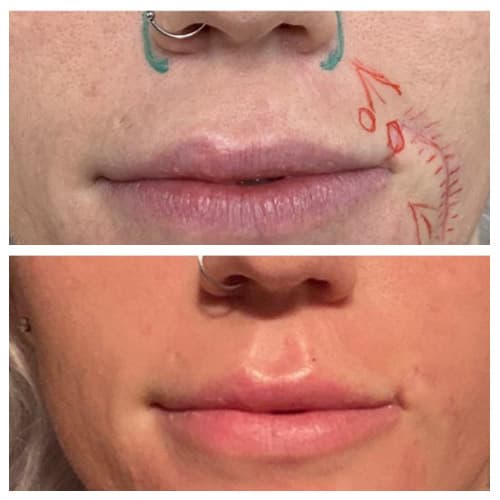
Lip filler result shown. Individual results vary.
Frequently Asked Questions
- Why see a dentist for injectables?
- Dentists work with the muscles, joints and nerves of the jaw and face every day. That makes a dental team well suited to treat clenching and TMJ-related muscle pain, and to plan cosmetic injectables that complement your teeth and smile.
- How long do dental Botox results last?
- Effects typically last about three to four months. With regular treatment, some patients find their jaw muscles become less overactive and results last longer.
- Is Botox FDA-approved for TMJ or teeth grinding?
- Botox is FDA-approved for several medical and cosmetic uses, but not specifically for TMJ disorders or teeth grinding. Using it for these conditions is considered off-label, which is common and legal in medicine and dentistry. We will explain the benefits and risks so you can decide.
- Does it hurt?
- Most patients describe a quick pinch. We use a very fine needle, and the injections take only a few minutes.
- Will I still be able to chew and smile normally?
- Yes. The dose is planned to reduce clenching force, not to stop your muscles from working. Some patients notice mild tiredness when chewing very tough foods in the first weeks, which usually settles.
- Are there side effects?
- The most common are temporary tenderness, small bumps or bruising at the injection sites, and occasionally a mild headache. Less commonly, chewing may feel weaker for a while, or a smile may look slightly uneven until the effect settles. Serious side effects are rare.
- Does Botox replace a night guard?
- Not always. Botox reduces how hard your muscles clench, while a night guard protects your teeth from contact. Many patients with heavy grinding benefit from both.
Related Reading

Ready to get started?
Schedule a consultation to discuss your Dental Injectables options.